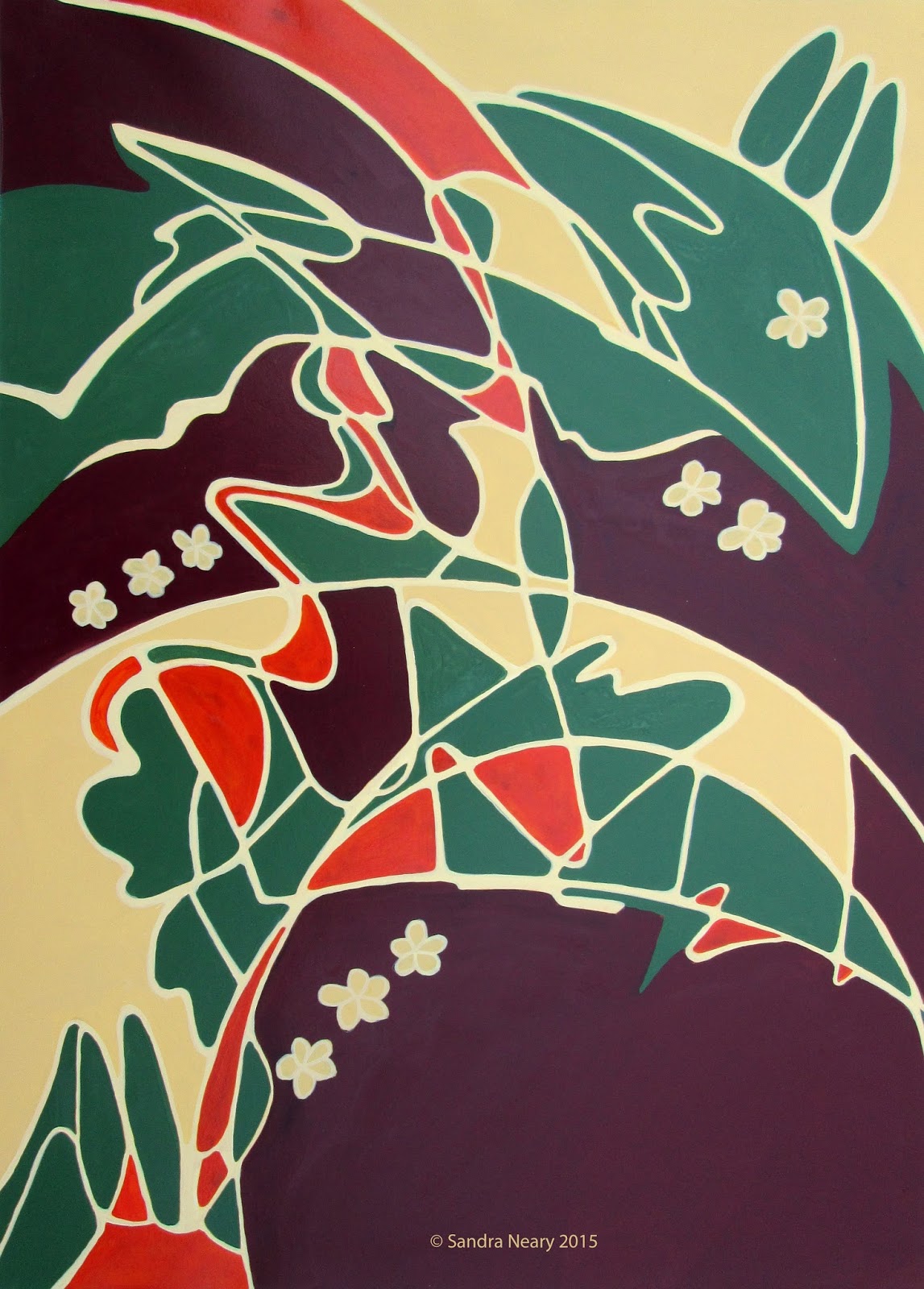
Friday, July 31, 2015

Competition Choices

Entries for the Watercolor Society of Oregon's fall show close tomorrow, which put pressure on me to review my inventory list to find those pieces which would meet the criteria of the show: (1) watercolor only (2) on paper, no yupo or other grounds (3) not painted in a workshop (4) not shown in a previous WSO show and (5) painted within the last two years.  Since I'm not painting a lot of watercolor pieces on watercolor paper right now the list of qualifying paintings was fairly short.   I'm allowed two entries.  I came up with three possibilities.  Two of these paintings have been submitted for a different show and were rejected.  The third has not been offered previously.

I prepared all three digital images for entry, resizing them and renaming them to fit the show entry criteria.  At that point I had to finally decide which two of the three to enter.  Self-evaluation is always difficult for me.  I am especially reluctant to offer works that have been refused by one juror for fear of a second rejection.  Usually 2 rejections does it for me.  By then the painting is getting "old" since the process often takes a few months and I may have newer, fresher work to offer.

I talked to my friend and instructor, Ruth Armitage, about this recently.  After a year of rejections, offering what I felt were very good pieces, I was feeling a little discouraged.  When should I "give up" on a painting? Ruth has experienced this cycle many times in her career.  There is no set answer to this issue.  Time and discouragement will take their toll on many wonderful pieces.  We can't know what any particular juror is going to accept or reject except by watching the shows those jurors put together to see if they have obvious preferences, for instance for portraits or landscapes, or obvious prejudices, for instance against non-representational work.

With all this in mind, I decided to submit "Klamath Lake Lily III" and "Klamath Lake Lily IV", both poured watercolor, both well designed and well executed.  The third piece, "Winter Solstice" would have been an excellent alternative but I felt the two lily paintings fit well together.  The decision is made, the entry sent in.  Wish me luck.


Thursday, June 11, 2015

Rethinking the concept of a "series"


In January I wrote about the confinement I felt in naming a body of work as a "series".  And now in June I find myself in the middle of a huge series based on impressions from my visit to the desert southwest in February and April.  I cannot seem to focus on anything else.  I feel I'm almost "caught" in this series and will stay here until all possibilities are exhausted!  I'm obsessed.

This experience helped raise my awareness of what fellow artists who paint in a "series" are telling me, especially when  I see multiple paintings by those same artists that are outside their current named series. While I was in Taos attending the Intensive Studies Seminar in April, Skip Lawrence defined a "series" as something that is 20 works or more.  I'm not sure where he came up with the number, but I'm there, in fact I've passed that magic number.

I think that a series can represent a
lot of things.  It can be a response to a particular subject, as my present series is, or it can represent a situation, a period of time, a thought or a mood.  We artists can see when we are changing course.  Every painting is different, every work speaks a new language.  When we start repeating that underlying language over and over we are in the middle of a series.  When we insist on change, on not being "stuck", then we are moving away from that series and moving into new territory.

Being an artist is the hardest, the most challenging and the most satisfying thing I've ever done in my life.  I want to label, identify, quantify (20 at least!!) and understand why I do what I do and why it works or it doesn't work.  I don't pick up a regular paycheck, I don't get some little ribbon or paper at the staff meetings anymore.  I work and work and work
and sometimes that work says a lot about one thing and sometimes it does not.  Currently I'm saying a lot about my personal response to the desert.  The first photo was, even though I didn't know it at the time, the signal that this series was starting.  It incorporated new colors and new shapes and I called it "Transitions" which turned out to be a very appropo title.  The second is  "Desert Scorpion" which is a huge simplification of shapes within this series.  The third is my most recent painting, "Desert Spring", which expresses how amazed I was at all the green that I saw in February. I've done 20 paintings plus.  Welcome to my current obsession, called the "Desert Series".

Wednesday, May 6, 2015

Intensive Studies Seminar - Taos, NM 2015

The fact that I had registered for and was going to attend the Intensive Studies Seminar in Taos drove my work for over 6 months. It sharpened me, encouraged me to take chances, to try new ideas and to show them to people. Then, suddenly, I was there, in the middle of it all, meeting wonderful people and seeing so much incredible artwork!  And now I'm back in my own studio space and thinking,
absorbing all the information and ideas discussed, looking at it's effect.  For me, personally, the effect of the ISS was almost all before the event even occurred.  I came home with one dozen new paintings.  The first three, done before any comments or instruction, are my favorites.  There are perhaps four more paintings that, after a little work, I will be pleased to own.  The rest is potential collage paper.

Before leaving home I volunteered, mentally, to be at the bottom of the group.  I wasn't.  I discovered every one of the 60 artists in that conference hall were and are unique in style, subject, ability, interpretation, goals and temperament.  Many had attended before, several for many years.  And of those repeat attendees, many do not paint regularly.  They
show up, year after year, hoping to get better.  Think of piano playing.  Practice piano once a year and see where you are in 10 or 13 years.  I apply the same piano analogy to an instructor painting on a student's work - one does not learn by watching someone else play the keys. One learns by doing.

Some of the best moments in the 2+ weeks I was gone were in non-workshop moments.  I was delighted with the galleries, talking to the owners, other artists.  I was happy with Taos and particularly happy with the surrounding land, the "plateau", the snow capped mountains, the Rio Grande gorge.  I ate antelope at a place that specializes in local and organic. I had several dinners out with new friends and a "fast food" Mexican place, Guadalajara Grill, an easy walk from the hotel and excellent food (plus margaritas and beer!).

I came home with a renewed sense of self-confidence.  3 of the 4
instructors said "keep on doing what you are doing".  I take that as a validation that I am moving along my path as an artist (or perhaps they were at a loss to say anything?!!).  The 4th advised that my work was "too noisy" and that competition is a waste of time and money.  I think that depends on a person's goals.

I think that out of all the instructors, Katherine Chang Liu was my greatest influence.  I painted to my SW desert theme, these three paintings, in the first two days.  "Desert Signs", "Desert Wishes" and "Desert Summer" were my first three works, undisturbed by instructor comment.  Notice how they got quieter.  Katherine said that usually happens in workshop.  She showed me how to find smaller designs for new pieces, which I did but ultimately found I preferred my own designs.

Take away advice: be true to yourself.  The rest will follow.  


Thursday, April 9, 2015

Art Workshops - How to Survive (and Profit)

As I write this post I am also preparing to leave for Taos NM for the "Intensive Studies Seminar".  This artist's workshop, in it's 20th and sadly final year, is lead by four top instructors: Catherine Chang Liu, Fran Larsen, Skip Lawrence and Christopher Shink.  I signed up last summer, probably one of the first.  The idea that I will be attending this workshop with these instructors has been driving me and influencing my painting ever since I signed up.  I don't want to look the fool, no one does, but I also want to learn as much as I possibly can.  I started thinking about workshops in my past, dozens of them and what I've learned by attending and by watching other artists in workshops.

The main thing I have learned over the years is that a workshop is NOT the place to show everyone how very fine you are, how advanced your work is, how wonderful you can be, how you are such good friends with the instructor (that actually gets to be annoying if you start to monopolize the instructor's time) or how you can help everyone else.  If you arrive with an attitude, you will make no friends and you might set yourself up for complete failure.  You will not have created the personal space to learn.

The space to learn requires an attitude of humbleness, not awesomeness.   Check your ego at the door.  Volunteer to be the least "successful" in the room, the one you are sure everyone will snicker at or feel a bit sorry for.  After all, someone has to be last.  Volunteer to occupy that post.   My experience has taught me that the bottom post in the workshop is the best post.  I experiment more, I try harder.  I also get more of the instructor's time, because obviously I don't know what I'm doing.  I'm struggling, I'm confused.  I'm just who the instructor needs to and wants to help.

There is another thing I've learned from years of painting workshops.  Not every instructor will give me something that "fits".  In fact, some will rattle my style and my content for a number of months, trying to "paint like the instructor".  Because of that, I've learned to be very choosy in my instructors. However, over the years every single instructor has always given me something, some little thing, some number of things, that has helped me move on in one way or another.  Attending a workshop is never a "loss".  I can always make a list of at least 10 things I learned from the experience and that's 10 more than if I had not attended.

We all tend to focus on the goal, the prize, being the "best", winning the ribbon, hearing the applause.  For me that comes from competition, not a workshop.  If I treat a workshop experience as competition, I lose.  If I treat a workshop as a time and place to learn, to grow, then I gain and the applause and the ribbon is waiting on down the line.

The painting with this post is "Signs" (14" X 21" acrylic on paper).  This was a transitional piece for me, following a workshop.  I take the advice offered by the instructor, I see if it fits, I try it out for a while, and then I either incorporate it or discard it.  I have the space required.  

Thursday, March 5, 2015

The Study of Silence

This winter I read a post about the study of silence in yoga.  The post suggested doing one's practice in silence and noticing the differences.  Most yoga classes play soft music and I was in the habit of playing music when I practiced at home.  I thought the idea interesting and gave it a try. I soon found that I was eliminating music from other things, like when I write every morning.  As much as I enjoy listening to music (I'm listening to it right now) I found that in some situations music was intrusive.

I decided to study silence in my work, my painting.  I painted for several days without my familiar music.   I wrote some notes about that experience and I'd like to share those thoughts.

1.  "To contemplate silence in art is more difficult and more interesting than contemplating the noise of a rock".
2.  "I challenge myself to work in silence so that I can better hear what the work is saying.  This would be like an explosion of silence".
3.  "I am noticing the noise of active shapes versus the peace of quiet ones, active versus restive."

Rocks can be very noisy.  They tell you, if you are interested in hearing, how they were formed, what they are made of, how long they've been, well, lying around.  Listening to a painting, instead of drowning it out with my own thoughts or with outside noise, is important and instructive.  The painting has a lot to say.  However, I think the last point I noted down was the most important.  I never noticed before how some paintings have a lot of "noise" and some are very quiet.  I became aware of that very recently.

Some artists paint quietly naturally.  Katherine Chang Liu and Elaine Daily-Birnbaum are two whose works immediately come to mind.  Most artists paint in the mid-noise level.  I looked at my works from the past couple of years and I see some I would call "noisy" and some I would call "quiet".  Noisy paintings have a lot going on.  They are jittery, have lots of shapes, colors, lots to look at.  Quiet paintings have large quiet spaces.   I admire quiet paintings.  I admire simple shapes and the use of sparing color.  I don't paint that way.  Why?  Because I'm a noisy active person.  I think the larger lesson in my study of silence was that absence of noise does not change or influence who I am. The person I am will always come out in my work.

The paintings included in this post are "Wings" (21" X 14" acrylic on paper) and "Universal Languages" (21" X 14" acrylic on paper) as some of my quieter work.  "Breaking Up" (29" X 21" acrylic on paper) is an example of my "noisy" work.

Tuesday, February 24, 2015

Courage

Every artist must have courage.   It is essential to what we do. Without it, no performer would ever get up on stage and risk ridicule and public humiliation, no singer would risk a bad note, no musician a missed key or beat,  no writer would submit a work for fear of rejection and no painter or photographer would ever show their work, for exactly those reasons.  It takes a great deal of courage to take our art, which is a bit of our soul, and offer it up, even to close friends or family.  To enter into competition requires the utmost courage and faith in one's work. A disassociated person will judge our work and find it to their liking, or not.  We artists never know why we are rejected or accepted.  No matter what our art form, we all go through the same process and it requires a great deal of courage.  

 My paintings are like children.  I'm sorry to lose one to a sale.  I want to keep them all close to me.  When I submit one into a juried show, I have double trouble.  Now I face the rejections or acceptace by someone completely unknown to me.  If my painting is accepted, in most cases the painting must be for sale.  I risk selling the work to someone completely unknown to me.  They will be walking off with my precious piece!  Will that person ultimately consign the painting to their attic? or worse, to a yard sale? or just give it away?  And worse thought - what if the piece is in the show and everyone wonders "why is this in here?"

For those of us who compete, we must step beyond all those thoughts and take our work and put it up for public judgment and display.  My painting "Habitat - Egret Hunts Frog" was recently accepted into the Watercolor Society of Oregon's spring 2015 show.  I offered two paintings to that juror.  The second "Counting Autumn's Days" was not accepted. One is suggestive, the other nonrepresentational.    Did that matter?  I have no idea!

I think it takes more courage to send a painting into competition than anything I ever did in life.  I've climbed mountains, kayaked rivers, backpacked, skied, hiked, run ultra marathons.  None of that compares to the feeling of sending a painting into a juried show and risking that rejection or acceptance.  


Saturday, January 24, 2015

The Concept of Painting in a Series

For over 15 years I have been told that it is very important that artists paint in a "series".  The series should have a goal.  The paintings within a series should be related to each other and visually connected. When an artist has exhausted all possibilities within the series, then they move on to a new series, never to return.  Although I've been pressed many times to declare that I work in a series, and I have even given names to various chronological periods of work ("Journey" and presently "Contemplation") I really don't see much division between the two.

What I do see when I review my work is growth over time and a whole bunch of "mini-series".  For instance, right now I'm in the middle of about 8 paintings where the subject is a begonia plant in bloom.  I've approached the concept using watercolor, gouache, acrylic inks and most recently poured watercolors.  I might do a collage.  Does this mean I'm in a "begonia" series?  I don't think so.  

In fact I don't think my brain or my artistic expression works that way.  I'm wondering if declaring a series and a goal confines me as an artist.  It's sort of a declaration that an artist will "stay in this box until I give up, run out of ideas or die..." Some people are comfortable with the concept, indeed several of my very good artist friends are painting in a series.  And several other wonderful artist friends are not painting in a series.

My most recent declared goal is to simplify my shapes and move away from rigid compositional forms, use shape and color with line and pattern more freely.  I think I'm accomplishing that.  And I think I will end the idea of declaring my work fits into a "series".  If I want to paint something that fits into Journey, I will.  If I want to paint something that fits into Contemplation, I will.  And if I want to paint something that doesn't fit anywhere, I will.